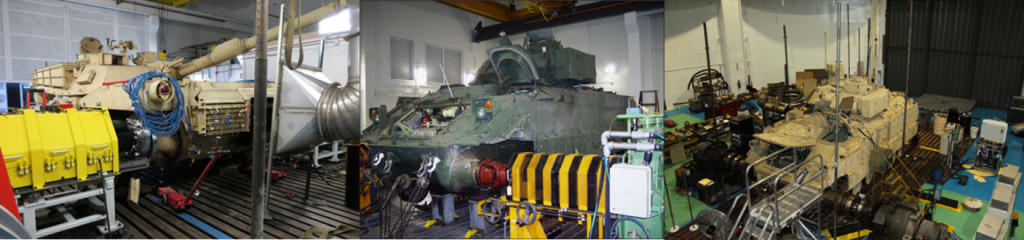
A vehicle isn’t proven until it performs under the conditions it was built for—and the ones it wasn’t. Extreme temperatures, sustained loads, electrical demand, and prolonged operation expose weaknesses that conventional testing never reveals. At the Power and Energy Vehicle Environmental Laboratory (PEVEL) and Propulsion Systems Laboratories (PSL), we deliver the rigorous, data-driven testing required to move ground vehicle technologies from development to operational confidence.
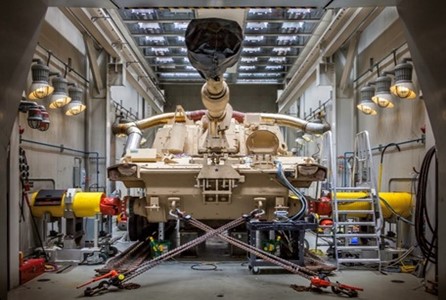
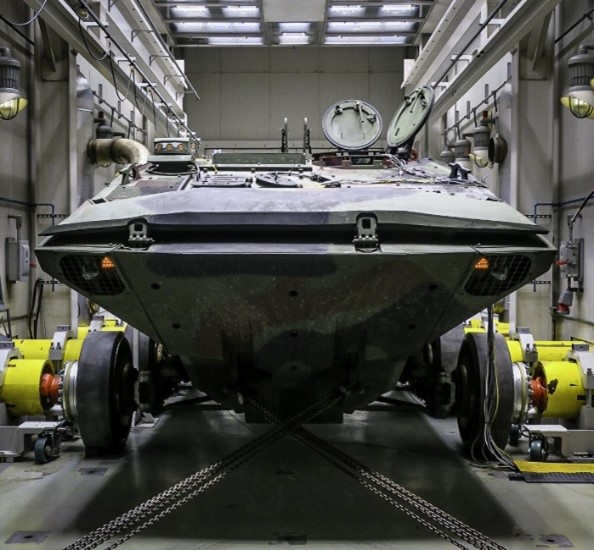
Together, PEVEL and PSL provide comprehensive, full-vehicle testing focused on performance characterization, durability assessment, and powertrain and systems integration. Using fully controlled, repeatable environments, we subject wheeled and tracked vehicles to the harsh operational scenarios they will face in the field—before those conditions become mission-limiting failures.
As ISO/IEC 17025–accredited laboratories, both PEVEL and PSL offer large-scale environmental chambers, advanced dynamometers, electrical loading capability, and integrated data acquisition to simulate the most demanding operational environments. Testing spans -60°F to 160°F, 5–95% relative humidity, wind speeds up to 60 mph, and solar loading up to 1,200 W/m², while applying precise road-load and drivetrain loads representative of real-world missions.
Environmental Endurance, Durability & Mobility Testing
Vehicles are subjected to prolonged operation under simulated road loads and extreme environmental conditions to evaluate long-term reliability, mobility, and system robustness. These tests expose vulnerabilities in powertrains, drivetrains, cooling systems, electrical architectures, and controls before they can compromise operational readiness.
- Benefit: Field vehicles with proven all-climate durability, reduced lifecycle risk, and validated mission reliability.
Powertrain Performance & Road-Load Mapping
Multiple dynamometers apply controlled, repeatable external loads—up to 34,000 lbf-ft per wheel for wheeled vehicles (up to 5 axles) and up to 105,000 lbf-ft per sprocket for tracked platforms. Transient road-load profiles, acceleration, speed-on-grade, fuel economy, and full-load cooling evaluations define the true performance envelope under realistic operational stress.
- Benefit: Confident performance margins, optimized efficiency, and validated cooling and thermal limits.
Electrical Loading, Thermal Analysis & Heat Rejection Evaluation
Electric loading capabilities allow realistic generator and electrical system loading during testing, ensuring accurate representation of operational demand. Advanced thermal instrumentation and measurement techniques identify heat rejection limitations, cooling system constraints, and potential hotspots.
- Benefit: Improved thermal management, hardened electrical architectures, and reduced risk of heat-driven failures.
Systems Integration & Development Testing
Functioning as a systems integration laboratory (SIL), both PEVEL and PSL support hardware-in-the-loop simulation and electrical power testing up to 800 kW. Compatibility with diesel, JP-8, F-24, hydrogen, biodiesel, and synthetic fuels enables evaluation of both legacy and next-generation propulsion systems. Targeted instrumentation and post-test inspections validate predicted failure modes and inform design refinement.
- Benefit: Eliminate integration unknowns, accelerate development, and field robust multi-axle and advanced powertrain platforms with confidence.
With accredited processes, unmatched environmental control, and deep technical expertise, PEVEL and PSL deliver actionable data that reduces risk, accelerates development, and ensures vehicles perform decisively across climates, terrains, and missions.
PEVEL/PSL: Full-vehicle performance—validated for the real world.